

146day

Reservation booth:+86(0)21-3114 8748
Visit/media contact:+8613601815988
QQ:2463282767
email:artsexpo@sgexpo.cn
Recently, Beijing Metro Operating Company piloted the installation of on-board shoe rail detection systems on one group of trains on Line 2, Line 5 and Line 10, which has been running stably since its launch, realizing the transformation of shoe rail operation and maintenance from "manual inspection" to "automated online monitoring".
The subway train obtains power from the "power supply rail" next to the track through the "power supply device" (collector boot) on the side of the car, which is like the "lifeline" of the train. In the past, the "lifeline" of inspection mainly relied on maintenance personnel to use the maintenance window at night and check one by one with flashlights, which was time-consuming and labor-intensive, and it was difficult to meet the operation and maintenance needs under high-density operation. To this end, focusing on the real-time identification and prevention of boot rail abnormalities, Beijing Metro launched the construction project of on-board boot rail detection system to provide data support for preventive maintenance.
The on-board boot rail detection system put into use this time is equivalent to equipping the train with a professional online "on-board doctor". During the operation of the train, it can automatically and real-time monitor whether the "power take" is good, whether there are abnormal sparks, and whether the key components are loose or dirty.
The vehicle shoe rail detection system innovatively integrates the three core technologies of non-contact laser measurement technology, image recognition technology and high-precision precision sensing technology to build an operation and maintenance system of "all-round detection + accurate analysis + intelligent early warning". It covers 8 types of key index monitoring such as contact rail geometric parameters, insulated porcelain bottle status, shoe rail arc, and contact pressure, and the detection accuracy reaches the industry's leading level.
After the system was put into use, it has successfully identified hidden dangers such as abnormal arc combustion of Line 2 and missing sub-nut of the contact rail of Line 10, and the accuracy of identifying the missing bolts of insulated porcelain bottles on the power supply rail exceeds 95%.
In the next step, Beijing Metro will continue to improve the "data-driven, intelligent early warning" boot rail operation and maintenance model, expand to more line coverage applications, promote data exchange with existing intelligent operation and maintenance platforms, and build a closed-loop management system of "status awareness-intelligent diagnosis-decision support" to provide more solid technical support for safe operation.
Further reading: The expansion and upgrading project of Beijing Metro's intelligent operation and maintenance platform was successfully completed
Recently, the expansion and upgrading project of Beijing Metro intelligent operation and maintenance platform successfully passed the final acceptance and final review. On the basis of the original intelligent operation and maintenance demonstration project, the project has completed functional upgrades and performance expansion, and comprehensively improved the standardization, digitalization and intelligence level of subway operation and maintenance management.
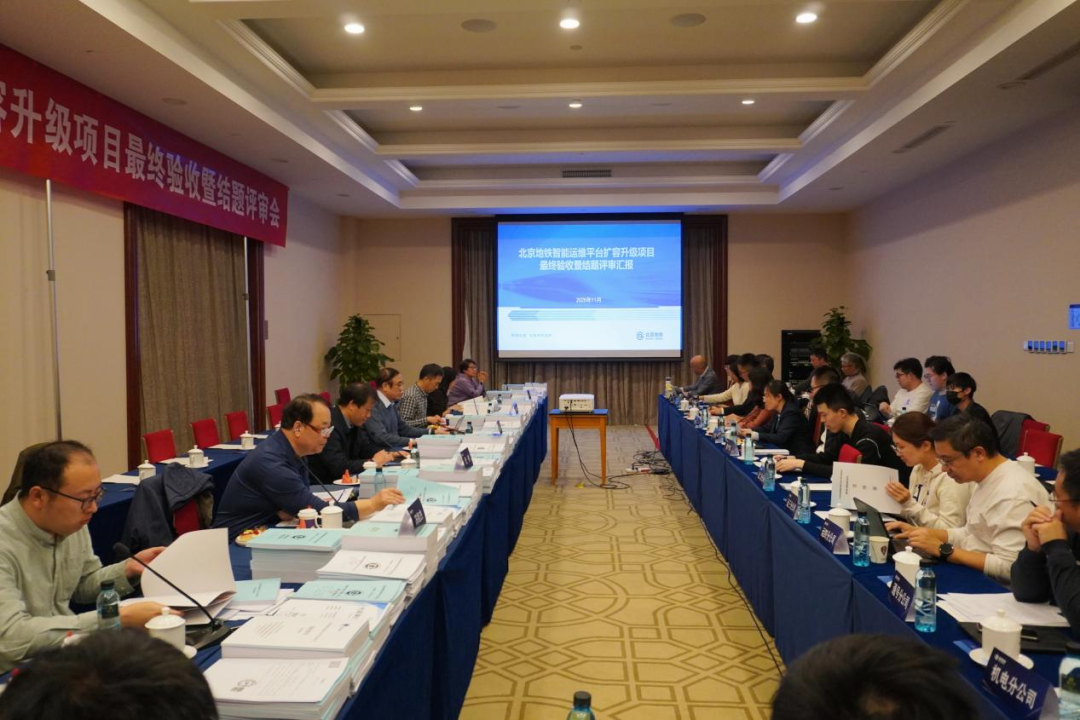
Since 2023, Beijing Metro Operating Company has launched an intelligent operation and maintenance platform expansion and upgrading project based on the concept of "iterative optimization and continuous empowerment" to promote the development of the operation and maintenance system to higher quality.
The upgraded intelligent operation and maintenance platform is composed of five major systems: intelligent maintenance, material management, intelligent early warning, comprehensive statistical analysis, and professional knowledge, forming a full closed-loop management of "perception-analysis-decision-execution-feedback". At present, the intelligent operation and maintenance platform has covered 18 operating lines and reserved interfaces for future new lines. At the same time, on the basis of the 17 enterprise standards formed by the demonstration project, 3 standards have been revised and 20 new standards have been added, and a complete standard system for asset maintenance and platform management has been built to break the "data island" and ensure the standardized circulation of data throughout the life cycle.
The highlights of the project innovation are highlighted:
The intelligent maintenance system covers the standardization of professional daily maintenance and maintenance of the company's entire line network equipment, realizes the digital replacement of paper work orders in 71 maintenance departments, and effectively improves the level of on-site maintenance quality control;
The material management system binds maintenance work orders and material receipts, making material control more accurate and efficient, and effectively improving inventory turnover;
The intelligent early warning system realizes the modeling and data analysis of equipment relationships in 5 types of cross-professional scenarios, and accurately traces back more than 28,000 parking records of Line 7 in the parking window offset scenario;
The comprehensive statistical analysis system realizes data penetration and intelligent research and judgment in the whole process of operation and maintenance through 16 theme modules;
The professional knowledge system creates 21 knowledge recommendation topics, has the ability to trace knowledge sources, and the "Ask Words" module shortens the efficiency of data query to minutes.
After the expansion and upgrade of the intelligent operation and maintenance platform, it has been fully applied to various equipment branches, technology innovation research institutes and other units, with more than 4,200 daily active users of the intelligent maintenance system, a total of more than 230 work orders, a standardized operation rate of 99.68%, and a material management system covering 2,106 warehouses.


